
The Uprising—Paul Greengrass’s film about the 1381 English uprising, aka the Peasants’ Revolt—has finally been released in the UK.
I am not going to write a review as such. Instead, I’m going to look at some of the historical background to The Uprising, not to myth-bust or fact-check (it’s a film, after all). I want to highlight where some of the ideas may have come from and the film’s place in the reception history of the 1381 uprising.
First, not everyone knows about the 1381 uprising, so I’ll give a brief overview (some of which is covered in the film), taken from my CDAMM entries on the revolt.
The English Uprising, 1381
In the summer of 1381, England saw unprecedented violent uprisings from peasants, serfs, artisans, village elites, townsfolk, local officials, and others against the lords, landowners, ecclesiastical leaders, and royal advisors. The most recognised leader, at least in the southeast, was Wat Tyler. Lower clergy featured prominently in the uprising (notably Ball) and articulated discontents in biblical, theological, and millenarian language. Rebels like Ball foregrounded the language of the Eucharist and the role and salvation of those who labour to make the bread. Ball argued that the peasant-lord relationship was imposed on human society and did not exist in the time of Adam and Eve. He was critical of the church hierarchy as part of the corrupt, exploitative system, as reflected in his ongoing battle with Simon Sudbury, the Archbishop of Canterbury at the time of the revolt. He saw the summer of 1381 as the time to rise up and overthrow the existing order, likely believing he would become the leading clergyman in England. Rebel interests and expectations of an England where all things were held in common involved access to game, parks, forests, and rivers, as well as townsfolk pushing for more rights and recognition. There were shared hopes for equitable political representation under a just king.
The uprisings took different forms across parts of England but, broadly speaking, were driven by hostility to aggressive taxation, a lack of protection against coastal invaders, the prevention of social mobility, and the exploitation of labour, alongside various grudges and vendettas. Decades earlier, the Black Death (1348/49) had wiped out possibly close to half the population. This meant significant changes in agriculture, land, tenancy agreements, and food supplies and prices. The shortage of labour meant workers could demand improvements in conditions and payment. With traditional feudal relations already in long-term decline, the aftermath of the Black Death brought new opportunities. Parliament pushed back, including attempts to cap wages and restrict mobility, most infamously through the Statute of Labourers of 1351. This fed into growing resentments and hostilities that came to the fore in 1381.
On Thursday, 13 June 1381—the feast of Corpus Christi (and celebration of the Eucharist)—rebels from the southeast arrived in London and swelled their ranks with Londoners and newly released prisoners. The festive timing was probably deliberate and was important for the revolt elsewhere, notably Bury St Edmunds. Though there were exceptions, it seems that the rebels were disciplined (with exceptions) and deliberately selected political, economic, legal, and ecclesiastical targets. The rebels negotiated with Richard II and made demands such as the end of serfdom, the pardon of criminals, and the removal or execution of royal advisors. Some rebels even got into the Tower of London and decapitated leading figures of the realm, including the Archbishop of Canterbury. Richard had accepted some key rebel demands, but Tyler and the Kentish rebels pushed further still, including a radical reshaping of the legal system, the aristocracy, and the church, which would be overseen by the king and one bishop. In the confusion that followed, Tyler was fatally wounded, and Richard was able to pacify the rebels. In the subsequent re-establishment of authority, Ball was captured in Coventry, tried in St Albans in mid-July, and hanged, drawn, and quartered, with his four parts sent to four cities.
The Tradition of Dead Generations
In addition to expected episodes of artistic licence, The Uprising follows the basic narrative inherited from the first chroniclers of the revolt (e.g., Thomas Walsingham, Anominalle Chronicle, Henry Knighton, Jean Froissart, Westminster Chronicle), refracted through centuries of tweaking, filling in gaps, and interpretation. To paraphrase Marx only slightly, film-makers certainly make their own history, but they do not make it as they please; they do not make it under self-selected circumstances, but under circumstances existing already, given and transmitted from the past. The tradition of all dead generations weighs like a nightmare on the brains of the living (Marx, Eighteenth Brumaire of Louis Bonaparte).
Whether the tradition of reception history of the 1381 uprising weighs like a nightmare, I don’t know. But The Uprising is the latest major interpretation of the revolt, with a 640-plus-year reception history behind it. And there is plenty transmitted from the past that the film inherits, uses, develops, and so on, and it is clear in innumerable details that Greengrass did much of this knowingly. To understand this, I’ll give a potted history of the reception.
Almost immediately, the ruling class and its writers presented the 1381 revolt as a dark moment in English history when the apocalypse hit. The problems of heavy-handed taxation and the changing economic situation were acknowledged. There was some acceptance that there had been a failure of governance. These reasons were intertwined with theological explanations explaining the breakdown in the apparently harmonious relationship between ruler and ruled, and ideas about divine providence, human morality, and sin. Nevertheless, writing about the revolt delegitimised any concerns rebels might have had. Despite some presentations of rebel discipline, they quickly became a wild, animalistic mob. Ball was regularly presented as the ultimate heretic and the seditious, demonic driving force of the revolt. Such readings of the revolt stayed in place for 400 years, even if there were different variations on the themes in different historical circumstances.
Towards the end of the eighteenth century, the reception history changed rapidly. Rebel demands were increasingly seen as reasonable, particularly as feudal relations were a thing of the increasingly distant past. In the 1790s, in the aftermath of the American and French revolutions, the assessment of 1381 shifted most dramatically. The revolt and Ball in particular could be seen as a representative of English radical or revolutionary thought. The revolt could be seen as an ongoing resistance against the Norman Yoke, the idea that, in 1066, William the Conqueror (or, rather, Bastard, as he was more typically known at the time) and the Norman invaders brought feudal oppression with him, thereby ending the age of Saxon rights and constitutionalism. In the nineteenth century, such ideas were taken up in reformist and socialist circles, a theme that continued until World War Two and persisted afterwards, albeit less prominently. Often, Tyler represented the threat of violence, Ball the ideology.
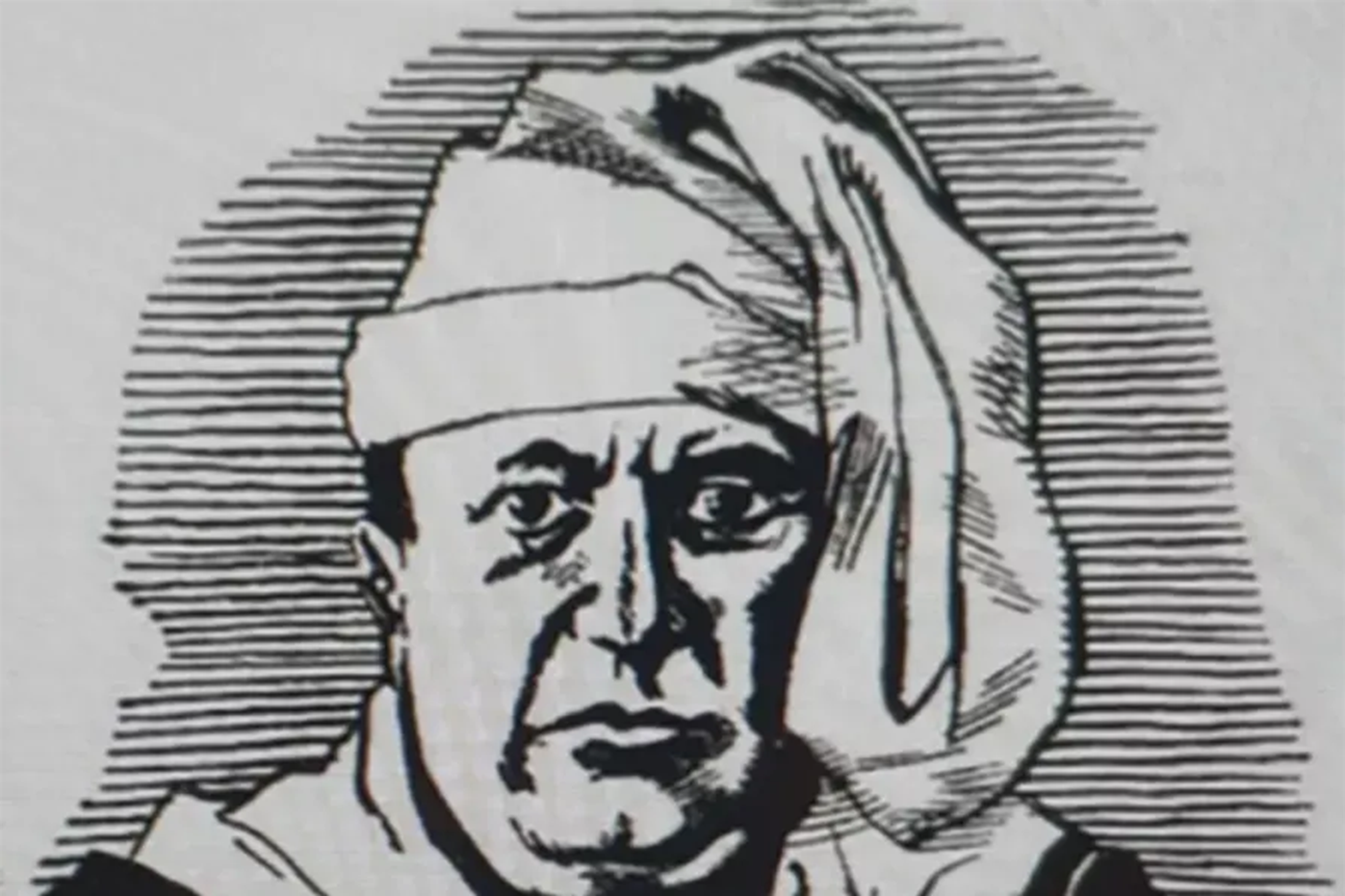
Interpreters continued to take the violence and religion seriously, even to the point of Ball being (sympathetically) viewed as a kind of mystic or ecstatic prophet in interwar England. Through art and novels, portrayals of the physical attributes of the rebels emerged. Portrayals could vary (e.g., sometimes Ball had a full head of hair, sometimes the tonsured priest didn’t, sometimes he was beaded, sometimes he was not). Nevertheless, from the nineteenth century onward, he was regularly portrayed as tough, even menacing, and not easily intimidated. He was often lean after suffering a period of imprisonment, though he occasionally received Friar Tuck’s sizeable treatment (to the point where the viewer could easily mistake one for the other). Other times, as in this example from the Daily Worker (19 July 1938), he could be a well-fed hardman and class warrior.
After the War, interest in Ball and the revolt declined (newspaper coverage, for instance, dropped dramatically). Nevertheless, two notable tendencies emerged (there were others, of course).
One is that Ball and the rebels represent a form of tolerant, antiracist social democracy or liberalism, fit for an era where too much religion in its dogmatic weirdness is embarrassing. This tendency downplays the violent aspects of the revolt, to the point of not even mentioning it—after all, celebrating the decapitation of the Archbishop of Canterbury might hinder the case for a well-funded National Health Service. Probably the most influential representative of this tradition is Sydney Carter, with his 1981 hymn “Sing, John Ball!” (or variations). Rather than wanting the execution of the leading figures of the realm, Carter’s Ball preaches love and vaguely hopes for the light coming in the morning.
Another tendency (of whatever political persuasion) lacks such constraints, or can at least perform them in the distant past. It concerns fictional portrayals, and indeed popular historical accounts, which rarely shy away from the violence or religious weirdness. These kinds of accounts almost have to be so. Imagine going to watch The Uprising and the rebels just talked about love for two hours, or went on a march only chanting for an end to this sort of thing. Of course viewers expect the wild violence!
The Uprising
In terms of modern reception, The Uprising is firmly (and expectedly) in the full-fat camp of portraying violence and overt religious beliefs, with Corpus Christi featuring relatively prominently. The film has unsurprising connections to Dan Jones’s popular historical account, with the telling title Summer of Blood: The Peasants’ Revolt of 1381 (2009) (unsurprising because Jones was the Historical Advisor for the film and has featured in its promotion).
In the chaos of the London uprising, the atmosphere is smoky red in a world set on fire, as the Ploughman put it. If the beheadings and slicing up don’t convince you that this is a portrayal of full-bloodied violence, then the moustachioed Walworth (Mayor of London, played by Jonny Lee Miller) might: he looks like a right bastard from the 1970s or 1980s.
John Ball (played by Jamie Bell) is both a class warrior and a borderline vengeful religious fundamentalist, with a hint of his historic reputation as a rabble rouser of the mob. This presentation comes at the expense of presenting Ball’s vision of a future England where all things were shared in common, presumably because the anger of the moment is the primary focus of The Uprising. Echoes of past interpretation can be detected in the account from Alyce (played by Thomasin McKenzie) of how Ball lifted her out of the darkness, Ball’s near-ecstatic response to the death of the Archbishop of Canterbury (played by Stephen Dillane), his belief in the events as the will of God, and his (justified in the film, it seems) belief in the Myth of the Norman Yoke. Even his lean physical appearance and skinhead belong to the tradition of Ball as, if not a hard man, then someone who could handle himself in a way that (say) a Church of England vicar probably could not.
For much of the film, the moderate counter to Ball is the Ploughman (played by Andrew Garfield). The Ploughman is the main character and is in the Everyman tradition, in this case the version made most famous by William Langland’s Piers Plowman, a text circulated on the eve of the 1381 revolt (the connection between the film and Langland’s dream vision is unlikely to be accidental, given Greengrass’s historical interests). By 1381, Piers Plowman was likely read and alluded to by rebels such as John Ball. It contains plenty of criticism of the behaviours of the priesthood and church hierarchy shared by Ball and others, but there were also differences. Put crudely, Langland was reformist, and the 1381 rebels were violently insurgent in their respective understandings of what needed to be done. Indeed, this tension between moderate reformism and violent revolt is played out in The Uprising through the characters of the Ploughman and John Ball, though there is a reconciliation of ideas towards the end of the film as the Ploughman finally realises what the people are really up against (see below).
The treatment of kingship in The Uprising follows the standard narrative, inherited (if significantly tweaked) from the first chroniclers. The ideas of a just king and kingship are an assumed part of the rebels’ worldview, but the film develops this (as others have previously) in light of the king tricking and slaying rebels. Richard II (played by the aptly named Woody Norman) is in cahoots with mercantile forces (represented by Walworth, the Mayor of London) at the expense of the leading nobles, and the King and Mayor’s Machiavellian conniving helps destroy the revolt. Richard comes out of his shell, eventually emerging as something like the Shakespearean version when he sees himself as the bringer of peace and proclaims himself the Messiah, no less.
But some rebels learn the lesson of this betrayal and the true nature of kingship. Histories of reception from the late eighteenth century onward tend to look for something to salvage from the failed revolt, such as inspiration for revolutionary, socialist, or reformist struggles, and hope that inherited dreams can finally be fulfilled. In The Uprising, the Ploughman, Alyce, and other rebels become outlaws, exact a notable revenge, and realise that killing a king merely removes an individual, as there will always be another. The outlaws remain (presumably) a shadowy presence, a nightmare haunting the aristocracy whose time will come.
Robin Hood?
So, was Robin Hood in The Uprising, as briefly promoted in America and caused some confusion?
According to Greengrass, the first draft of the film was called The Hood and “that was what it was called because of where it ended. And actually, it really didn’t change very much.” The outlaws at the end certainly look like Robin Hood and his band of popular imagination, and viewers could be forgiven for making a connection between the Ploughman and Robin. They wear green, their faces are half covered, they shoot arrows, they ambush the wealthy on the forest road, and they live in their own community under their own rules outside the norms of society.
In the Metro, Tori Brazier explained her puzzlement:
A lot of this confusion remains, given the dates don’t match for Robin Hood (we’re about 200 years too late here) and there is no proper attempt to tie in that legend, other than by Andrew Garfield donning a hood and wielding a bow and arrow after nearly two hours to hold up a carriage, and the link of his name to a poem referencing the folktale.
Maybe that’s enough for US fans, but it makes for a distracting and quite painful conflation for anyone British who remembers their school history lessons – and very odd so far into the film.
It’s nonsense ‘context’ I wish we’d never been distracted with, especially because this period is largely unexamined in cinema and could speak for itself.
The surprise in some quarters about the (apparent) appearance of Robin Hood should be less surprising in light of the history of reception of 1381. Like John Ball and Wat Tyler, Robin Hood re-emerged as a radical and socialist English hero from the late eighteenth century onwards (though not without precedent). With the romantic medievalism of the nineteenth century (and onward), their reception histories were intertwined to the point that the gangs looked strikingly similar, with Ball sometimes taking on the role of the friar.
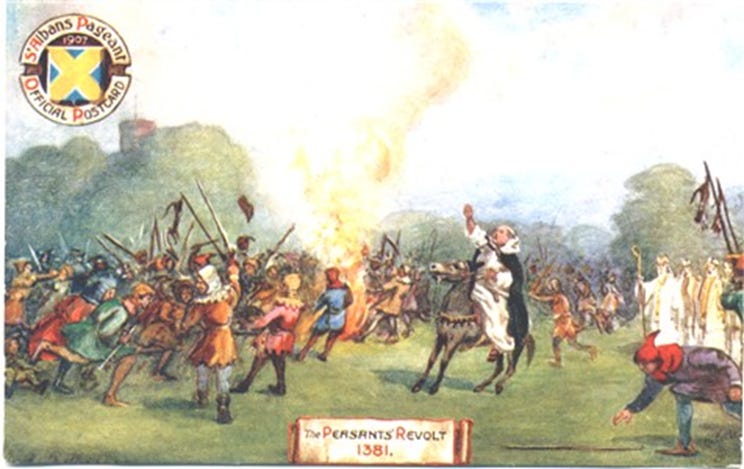
In William Morris’s A Dream of John Ball, a ballad of Robin Hood is sung, ushering in Ball himself (ch. II). The 1381/Robin Hood overlap continued into the twentieth century, albeit relatively muted compared to the romantic medievalism of the nineteenth-century heyday. A Daily Worker article (21 November 1953), for instance, compared Ball’s thinking with the stories of Robin Hood, claiming both shared an English version of primitive communism. Occasional, scattered comparisons continued in the rest of the twentieth century.
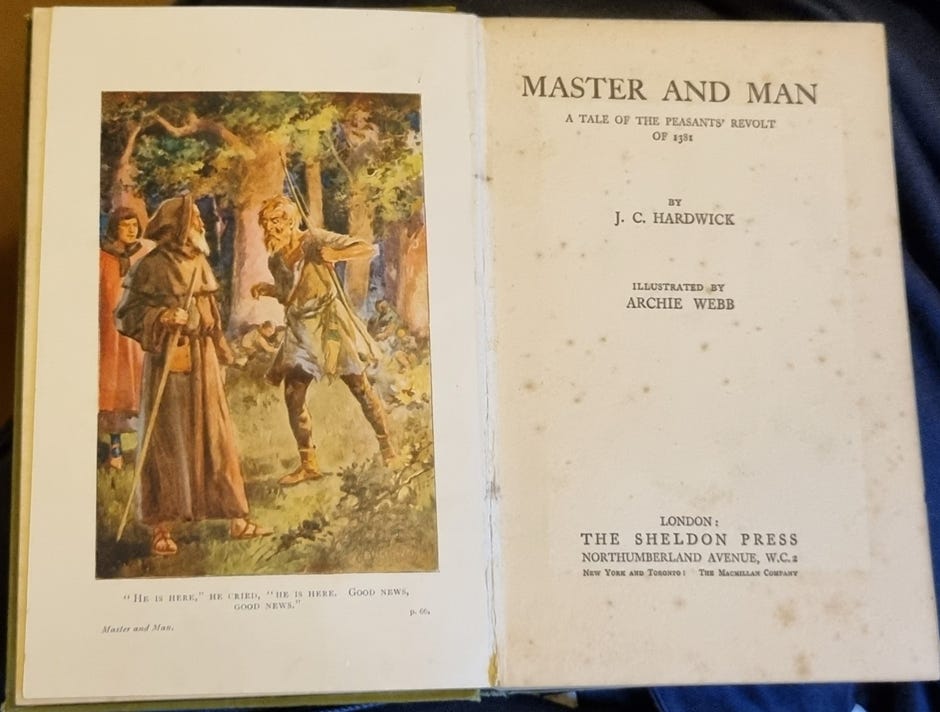
The British Marxist historian Rodney Hilton believed that there were shared material interests between the early Robin Hood stories and the 1381 uprising. Hymie Fagan and Hilton also argued that the Robin Hood stories should take their place in the “literature of revolt,” alongside not only Ball’s sermon, but the literature of the English Revolution and of the modern working-class movement (Hilton and Fagan, The English Rising of 1381 [1950], 89; Hilton’s most famous treatment of Robin Hood stories is “The Origins of Robin Hood,” Past and Present 14 (1958): 30–44 ). Greengrass himself is in this interpretative tradition. As he put it in a recent interview:
[W]hen the Peasants’ Revolt was crushed, people didn’t stay crushed, the dream stayed alive in human history. And one of the principle [sic] ways it stayed alive was that people started to tell stories about outlaws. The late 14th century, you see this huge bubbling up from underneath. The [stories] weren’t courtly poems, they were the stories that people told in taverns and village squares. They were the people’s stories, they were stories of outlaws. And most of all, stories of the legendary figure. Not a real person, because there never was a real person for Robin Hood. But Robin Hood, the ballads all postdate the Peasants’ Revolt and were wildly popular and continued to resonate and echo down. Why? Because at a time when people felt that the world was unjust, telling stories about an outlaw who stood up against power when they themselves felt powerless, that kept the dream alive. That’s where the legend of Robin Hood began and why it began.
Hilton’s and Hilton-style arguments have been widely discussed and regularly challenged. There have been plenty of attempts to locate who wrote the Robin Hood stories and the target audience in late medieval England (for discussion with bibliography, see my CDAMM entry on Early Robin Hood Stories). But one thing now seems clear enough: there was a diverse popular audience, from frequenters of taverns and games through emergent yeomen, clergy, merchants, guildsmen, and gentry, and even right up to Henry VIII. If there was potential for radicalism and revolt in the stories, it was sufficiently domesticated in the early Robin Hood stories. They also express strong loyalty to the king, even though tensions remain over their outlaw behaviour.
However, the tensions remained (not least because of the diversity of audiences), and we should not entirely get rid of Hilton’s and Hilton-style understandings. Intriguingly, our first clear indication of the telling of the Robin Hood stories turns up on the eve of the revolt in Piers Plowman, no less, a connection that would not be lost on Greengrass and those involved in The Uprising. Here the complaint is that a clergyman does not know the paternoster but does know the “rymes of Robyn hood” and enjoys the ale house (Piers Plowman B 5.385–421). There is also a possible (and we can say no more than that) reference to interest in the Robin Hood stories in a court roll of Chevington (manor of Bury), an area where the prising was especially violent: a brewer called John, who went by the nickname “Littlejohn” (see Christopher Dyer, Everyday Life in Medieval England [1994], 232).
More concretely, Friar Tuck turns up in legal records of banditry as an alias. In 1417, for instance, the chaplain Robert Stafford apparently assumed the name “Frere Tuk.” His band were accused of poaching, violently entering parks and warrens in Surrey and Sussex, hunting and taking deer, hares, pheasants, rabbits, and partridges while threatening the keepers and burning their lodgings (see further Calendar of the Patent Rolls Preserved in the Public Record Office: Henry VI, Volume 2 [1429–1436] [1907], 10; Calendar of the Patent Rolls Preserved in the Public Record Office: Henry V, Volume 2 [1416–1422] [1911], 84, 141). Whenever Friar Tuck may have entered the Robin Hood tradition, the interests and actions undertaken in his name were the kinds associated with the 1381 uprising. Other comparable uses turn up in late medieval England. The names of Robin and others were used as aliases for those involved in violent gangs (or at least in allegations) and indeed used to describe rebellious activities. Robin Hood’s name was referenced, for instance, in disturbances in the build-up to Jack Cade’s rebellion, and parallels between the outlaw story, the 1381 uprising, and Cade’s uprising have long been noted.
Whatever the diversity of interpretation of the widely disseminated Robin Hood stories, one tendency was that the names of Robin and some of his men still carried a violent threat, whether used by bandits, rebels, or those accusing others of banditry and rebellion. A breakthrough in anti-monarchical theory, the late medieval Robin Hood tradition may not be. But some shared interests between 1381 and Robin Hood exist, and the connections would continue in different ways throughout the history of reception. The connection made in The Uprising is not from nowhere.

